
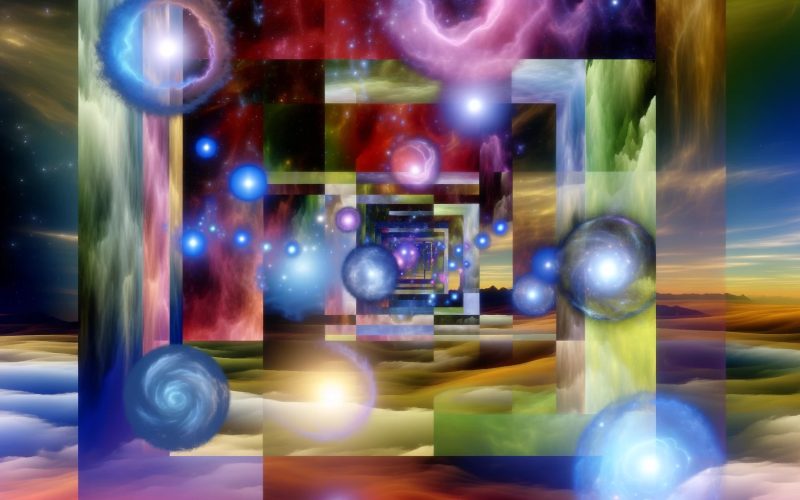
The idea of multiverse, many parallel universes existing next to our own, is fascinating scientists, philosophers, and thinkers since long time. This concept says our universe, with all galaxies, stars, and celestial bodies, is just one among infinite numbers of universes, each having own unique physical laws and properties.
The theoretical beginnings of multiverse can be traced to early 20th century, when quantum mechanics and relativity were developing. Physicists like Erwin Schrödinger and Hugh Everett were exploring what quantum superposition means, suggesting reality could be in many states at same time. Philosopher David Lewis expanded these ideas, saying all possible worlds and realities are real and exist as part of bigger multiverse.
“Multiverse idea came in many versions, mainly in cosmology, quantum mechanics, and philosophy, often saying real physical existence of different possible configurations or histories of observable universe we know,” explains Encyclopedia Britannica.
While existence of multiverse is still a speculation, its implications are deep. If it’s true, it would change deeply how we understand universe and our place in it.
Types of Multiverses
Multiverse concept includes many theories and models, each suggesting different ways how parallel universes are formed and interact. These are broadly categorized as:
- Disconnected multiverses: These models say parallel universes exist by themselves, no connection or interaction between them. Examples are modal realism, where all possible worlds are real, and mathematical universes, saying all mathematical structures have physical reality.
- Quantum-based multiverses: These theories come from quantum mechanics and say new universes can be made through quantum processes. Cyclical cosmologies think collapse of one universe can lead to formation of another, while “baby universes” idea says new universes can grow from existing ones through quantum gravitational processes.
- Inflationary multiverses: Based on cosmic inflation idea, these models suggest our known universe is just one among many from exponentially expanding space-time region. Eternal inflation and string theory landscapes are examples, where new universes with different physical laws and constants keep coming.
- Quantum mechanical multiverses: The many-worlds interpretation of quantum mechanics is well-known theory, proposing every possible outcome of quantum event happens in separate, parallel universes. This suggests our universe is always splitting into many branching realities.
Inflationary Multiverse
One big theory of multiverse is based on cosmic inflation, a thought period in early universe when space-time expanded very fast. This model says our observable universe is small part in much bigger multiverse.
“Inflation is thought process in early universe where space-time expanded exponentially much faster than now,” explains Encyclopedia Britannica. “This exponential expansion creates space-time much bigger than observable universe and leads to very connected multiverse made of regions very similar to observable universe.”
In this inflationary multiverse, new universes keep coming through a process called eternal inflation. In some places, inflation might still happen, causing constant creation of new universes with different physical laws and properties.
Quantum Mechanical Multiverse
Many-worlds interpretation of quantum mechanics, proposed by physicist Hugh Everett, gives strong argument for multiverse existence. This theory says when quantum system is measured, it doesn’t just collapse into one state as classical physics would suggest. Instead, it splits into many parallel universes, each showing different possible outcome of measurement.
“According to quantum mechanics, a system can be described by states for different outcomes of physical measurement of system by macroscopic apparatus,” explains Encyclopedia Britannica. “Everett suggested this is artifact of treating measuring apparatus classically. He instead proposed apparatus (and any observers) interacting with quantum system just ‘enlarge’ superposition to include superposition between macroscopic states where different experimental outcomes happen.”
This means every quantum event creates many parallel universes, each with different version of reality. While these universes may start closely connected, process of decoherence gradually separates them, making interaction between them nearly impossible.
Evidence and Observations
Idea of multiverse is interesting from theory side, and scientists are looking for observational evidence to support or refute its existence. Some ways to find evidence of multiverse include:
- Cosmic microwave background (CMB) observations: If our universe collided with another universe long ago, it could leave marks as distortions or anomalies in CMB radiation.
- Black hole signatures: Some types of black holes might be results of parts of our universe separating into own universe through quantum tunneling process. Finding these unique black holes could show evidence for multiverse.
- Gravitational wave detection: Collisions between universes in inflationary multiverse might make gravitational waves that could be detected by future experiments.
However, no definite evidence for multiverse found yet. It’s challenging to find evidence as our observation abilities are limited to our observable universe, hard to look beyond its boundaries.
Implications and Speculations
Existence of multiverse opens many big philosophical and existential questions. One strange idea is possibility of doppelgängers – infinite versions of us existing in parallel universes.
“Because concept of inflation has good theoretical support and observational backing, and because process of making new universes through inflation is based on well-understood physics, this multiverse model has become much more prominent than earlier ideas,” notes Encyclopedia Britannica.
If truly infinite number of universes exist, same patterns and configurations would repeat, eventually leading to identical scenarios and copies of us across multiverse.
Multiverse concept also gives potential explanation for fine-tuning of physical constants in our universe, which seem uniquely right for life existence. So-called anthropic principle thinks in huge multiverse, it’s not surprising at least one universe would have right conditions for life.
“This sort of multiverse is called ‘eternal inflation/string landscape,'” explains Encyclopedia. “Because physical constants take many values in many real universes, this framework has been proposed as anthropic explanation for why certain physical constants take value compatible with life-suitable universe but very different from ‘natural’ value.”
Conclusion
Idea of multiverse is very captivating and makes us think deeply, challenging our basic understanding of universe and our place in it. While various multiverse theories give interesting explanations for cosmic observations and philosophical puzzles, they remain highly speculative and lack definite observational evidence.
Despite lack of solid proof, multiverse concept continues to inspire scientists, philosophers, and thinkers to push knowledge boundaries and explore possibilities. As our observation abilities and theoretical frameworks grow, maybe one day we’ll find clues about existence or non-existence of parallel universes.
Ultimately, multiverse remains big mystery, inviting us to question our assumptions, embrace unknown, and keep pursuing understanding of cosmos in all its complexity and wonder.
FAQs
How is multiverse different from parallel universes or alternate realities?
Multiverse is broader concept including all possible parallel universes or alternate realities. Parallel universes or alternate realities refer to specific versions of multiverse existing next to our own universe.
If multiverse exists, does it mean our universe is not unique?
Yes, existence of multiverse would mean our universe is not unique, but one of potentially infinite versions of reality, each with own unique physical laws and properties.
Can we ever directly observe or interact with other universes in multiverse?
Most multiverse theories say direct observation or interaction with other universes is nearly impossible due to huge distances and fundamental differences between universes. However, some theories suggest possible observational signs or indirect evidence that could be detected.
How do different multiverse theories fit with our current understanding of physics?
While some multiverse theories, like inflationary multiverse and many-worlds interpretation, are based on established physics principles, others, like disconnected multiverses or mathematical universes, remain highly speculative and challenge our current physics laws.
What are philosophical and existential implications of living in multiverse?
Existence of multiverse raises deep questions about reality, consciousness, and our place in cosmos. It challenges traditional ideas of uniqueness, free will, and role of observers in shaping reality. Also, it makes us think about infinite versions of ourselves existing across parallel universes.